
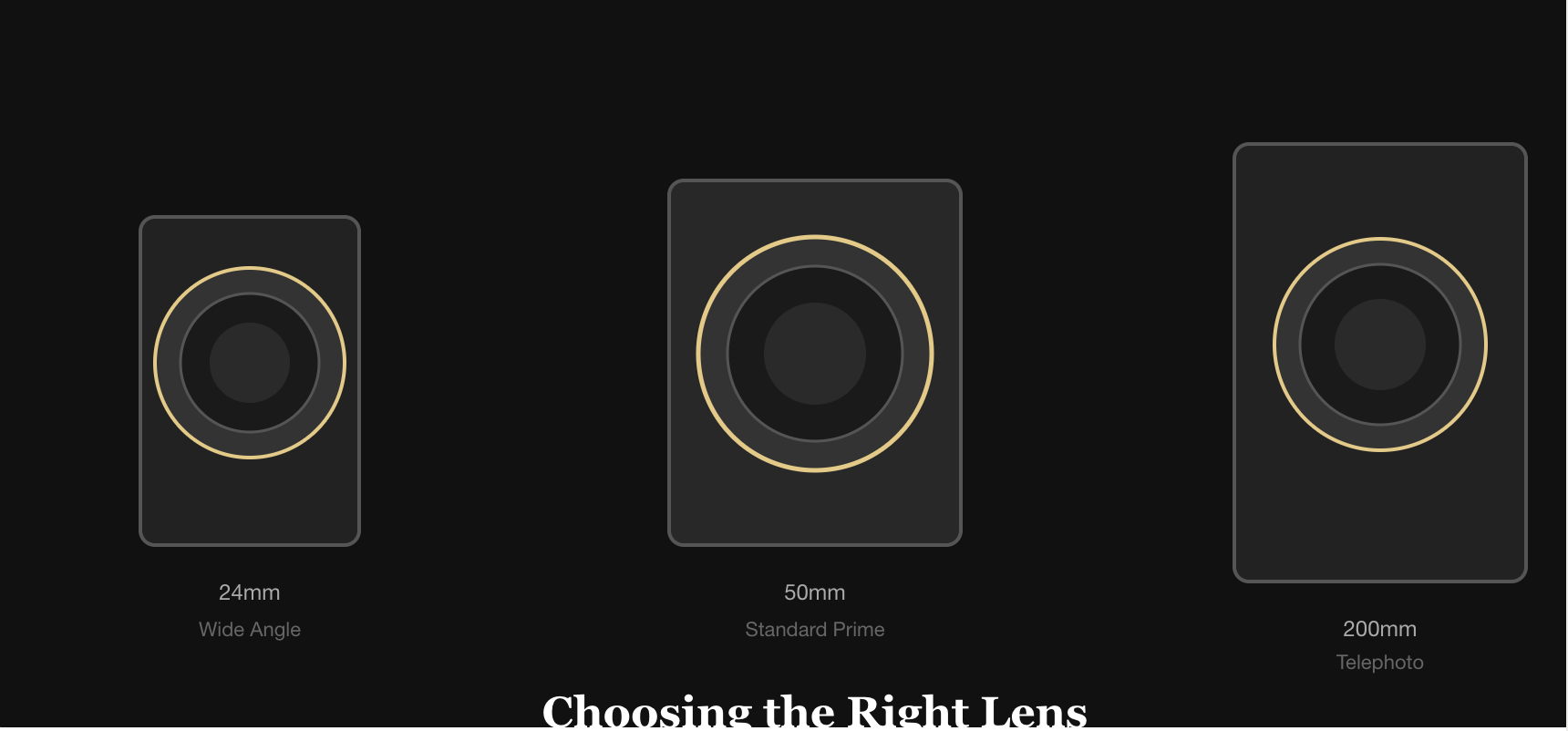
If the camera is the body of photography, the lens is the eye. No piece of equipment has a greater influence on the character and quality of your images than the glass through which light travels to reach the sensor. Understanding the strengths, limitations, and ideal applications of different lens types is fundamental to making informed creative and technical choices.
Understanding Focal Length
Focal length, measured in millimetres (mm), determines the angle of view a lens captures and the apparent magnification it produces. A shorter focal length produces a wider angle of view; a longer focal length narrows the field of view and magnifies distant subjects.
Wide-Angle Lenses (14mm – 35mm)
Wide-angle lenses capture expansive scenes and are indispensable for landscape, architecture, real estate, and environmental portrait photography. They exaggerate perspective, making foreground elements appear larger and backgrounds more distant. Ultra-wide lenses (below 20mm) can introduce barrel distortion, which is sometimes used creatively.
- Best for: Landscapes, interiors, environmental portraits, travel
- Consider: 24mm f/1.4, 35mm f/1.8
Standard Lenses (40mm – 60mm)
The 50mm lens most closely approximates the natural field of view of the human eye, producing images that appear true-to-life in terms of perspective. The 50mm f/1.8 (“nifty fifty”) is one of the most affordable and optically excellent lenses available for any camera system — an ideal first prime lens.
- Best for: Street photography, documentary, everyday photography, portraits
- Consider: 50mm f/1.8, 40mm f/2.8
Short Telephoto Lenses (70mm – 135mm)
The 85mm is widely regarded as the ideal portrait focal length. It provides a pleasing perspective compression (slightly flattering facial features), a comfortable working distance, and the ability to achieve beautiful background separation. The 105mm macro doubles as an excellent portrait lens.
- Best for: Portraits, product photography, headshots
- Consider: 85mm f/1.8, 135mm f/2
Telephoto Lenses (200mm – 600mm)
For subjects you cannot approach — wildlife, sports, birds in flight, candid street from a distance — a telephoto lens is essential. The compression of perspective they produce, collapsing distances between subject and background, can be extraordinarily beautiful in the right context.
- Best for: Wildlife, sports, aviation, nature
- Consider: 70–200mm f/2.8, 100–400mm f/4.5-5.6
Prime vs. Zoom
Prime lenses (fixed focal length) are typically faster (wider maximum aperture), sharper, and lighter than zooms, but require you to “zoom with your feet.” Zoom lenses offer flexibility and versatility at the cost of some speed and optical quality. Neither is inherently superior — the right choice depends on your shooting style and subjects.
“The best lens is the one that sees what you see, and then a little more.”
Conclusion
Resist the temptation to accumulate lenses prematurely. Master one focal length deeply before adding another. The constraint of a single lens sharpens your compositional thinking and teaches you to see more creatively within its limitations.